
L’IRASEC a pour vocation de développer la recherche en sciences humaines et sociales sur et dans les pays d’Asie du Sud-Est – Birmanie, Brunei, Cambodge, Indonésie, Laos, Malaisie, Philippines, Singapour, Thaïlande, Timor-Leste et Vietnam – et sur la région dans son ensemble.
IRASEC’s mission is to develop research in the humanities and social sciences on and in the countries of Southeast Asia—Burma, Brunei, Cambodia, Indonesia, Laos, Malaysia, the Philippines, Singapore, Thailand, Timor-Leste and Vietnam—and on the region as a whole.
Symposium // Symposium
Un symposium consacré aux influences juridiques
entre la France et la Thaïlande
A symposium dedicated to legal influences
between France and Thailand
8-9 juin 2026, Faculté de Droit, Université de Thammasat, Bangkok
8-9 June 2026, Law Faculty, Thammasat University, Bangkok
À l’occasion des 170 ans des relations diplomatiques entre la France et la Thaïlande, l’Université de Thammasat a organisé conjointement avec le service du magistrat de liaison en poste à l’ambassade de France, les 9 et 10 juin 2026 à Bangkok, un Legal Symposium sur les «Perspectives et influences juridiques», réunissant universitaires, magistrats, institutions et experts des deux pays.

Pendant deux journées, les intervenants thaïlandais et français, dont certains membres de la Fondation pour le droit continental, ont abordé les principales étapes de la modernisation du droit thaïlandais, l’évolution des institutions juridiques, les échanges académiques franco-thaïlandais ainsi que les grands défis contemporains auxquels sont confrontés les deux systèmes juridiques.
Dans ce cadre, Magalie Bourdier, chargée de coopération juridique à l’IRASEC, est intervenue lors de la table ronde consacrée à la diplomatie, la politique et l’occidentalisation du droit thaïlandais. Son intervention a retracé le processus de modernisation du droit thaïlandais engagé à la fin du XIXᵉ siècle sous le règne du roi Chulalongkorn, marqué par l’introduction progressive des grands principes du droit continental européen et, notamment, par l’influence du droit français dans la codification des textes thaïlandais.
Celebrating the 170th anniversary of diplomatic relations between France and Thailand, Thammasat University, in partnership with the Liaison Magistrate’s Office at the Embassy of France, hosted a Legal Symposium on “Legal Perspectives and Influences” in Bangkok on June 9–10, 2026, bringing together academics, judges, institutional representatives, and experts from both countries.
Over two days, Thai and French speakers—including some members of the Foundation for Continental Law—addressed the main stages of the modernization of Thai law, the evolution of legal institutions, Franco-Thai academic exchanges, as well as the major contemporary challenges facing both legal systems.
Within this framework, Magalie Bourdier, Legal Cooperation Officer at IRASEC, participated in the roundtable discussion on diplomacy, politics, and the Westernization of Thai law. Her presentation traced the process of modernization of Thai law initiated in the late 19th century during the reign of King Chulalongkorn, marked by the gradual introduction of the major principles of continental European law, particularly the influence of French law in the codification of Thai legal texts.


Appel à communication // Call for paper
Becoming Infrastructure : Digital Ubiquity, Societal Transformation, and Spaces of Possibility
Elisabeth Peyroux, chercheuse à l’IRASEC, en collaboration avec des collègues de l’Université Nationale de Singapour (NUS) invitent les chercheurs et universitaires à soumettre des propositions pour un atelier interdisciplinaire explorant le rôle désormais central du numérique dans le fonctionnement des sociétés contemporaines.
Cet atelier accueille des contributions fondées sur des recherches empiriques, notamment des études ethnographiques et d’autres formes de recherche qualitative menées principalement en Asie.

Elisabeth Peyroux, a researcher at IRASEC, together with colleagues from the National University of Singapore (NUS), invites researchers and scholars to submit proposals for an interdisciplinary workshop examining how digital technologies have become a critical infrastructure underpinning contemporary societies.
The workshop welcomes papers grounded in empirical research, particularly ethnographic studies and other qualitative approaches focusing primarily on Asian contexts.
📅 Workshop: 18-19 February 2027 — Singapore
⏰ Submission deadline: 10 July 2026
✈️ Full or partial travel funding available for overseas participants, as well as three nights of accommodation in Singapore.
Conférence // Conference
A Vietnamese Le Canard Enchaîné ?
The Vịt Đực newspaper and the pursuit of Vietnamese satire in the final interwar years (1938-1939)
26 June 2026, 5:30pm - 7pm (Vietnam Time, UTC +7)
Hosted by EFEO at Ho Chi Minh City
113 Hai Bà Trưng, Bến Nghé, D. 1
Cette conférence présentera Vịt Đực — un journal satirique en langue vietnamienne publié de juillet 1938 à juillet 1939. L’exposé abordera quatre aspects de ce journal : la création du journal et le parcours de ses fondateurs au sein de l’univers intellectuel de Hanoï coloniale des années 1930, l’influence du Canard Enchaîné sur Vịt Đực, l’adaptation à un contexte local et la ligne politique contestataire du journal au travers de l’analyse de rubriques sélectionnées.
Dans un contexte marqué par l’échec des réformes coloniales et l’effondrement impérial en prévision d’un nouveau conflit mondial, l’engagement de Vịt Đực en faveur d’une satire populaire et d’un apolitisme affiché proposait une vision alternative du Vietnam, dépassant les clivages entre monarchisme, républicanisme et communisme.
This presentation introduces Vịt Đực — a Vietnamese language satirical newspaper published from July 1938 to July 1939. The presentation will discuss four aspects of the newspaper. First, it will introduce the formation of the newspaper and the biographies of its founders within the intellectual world of colonial Hanoi in the 1930s. Second, it will discuss the influence of Le Canard Enchaîné on Vịt Đực. Third, it will describe how the newspaper successfully localized the verbal and visual humor that its French counterpart espoused.
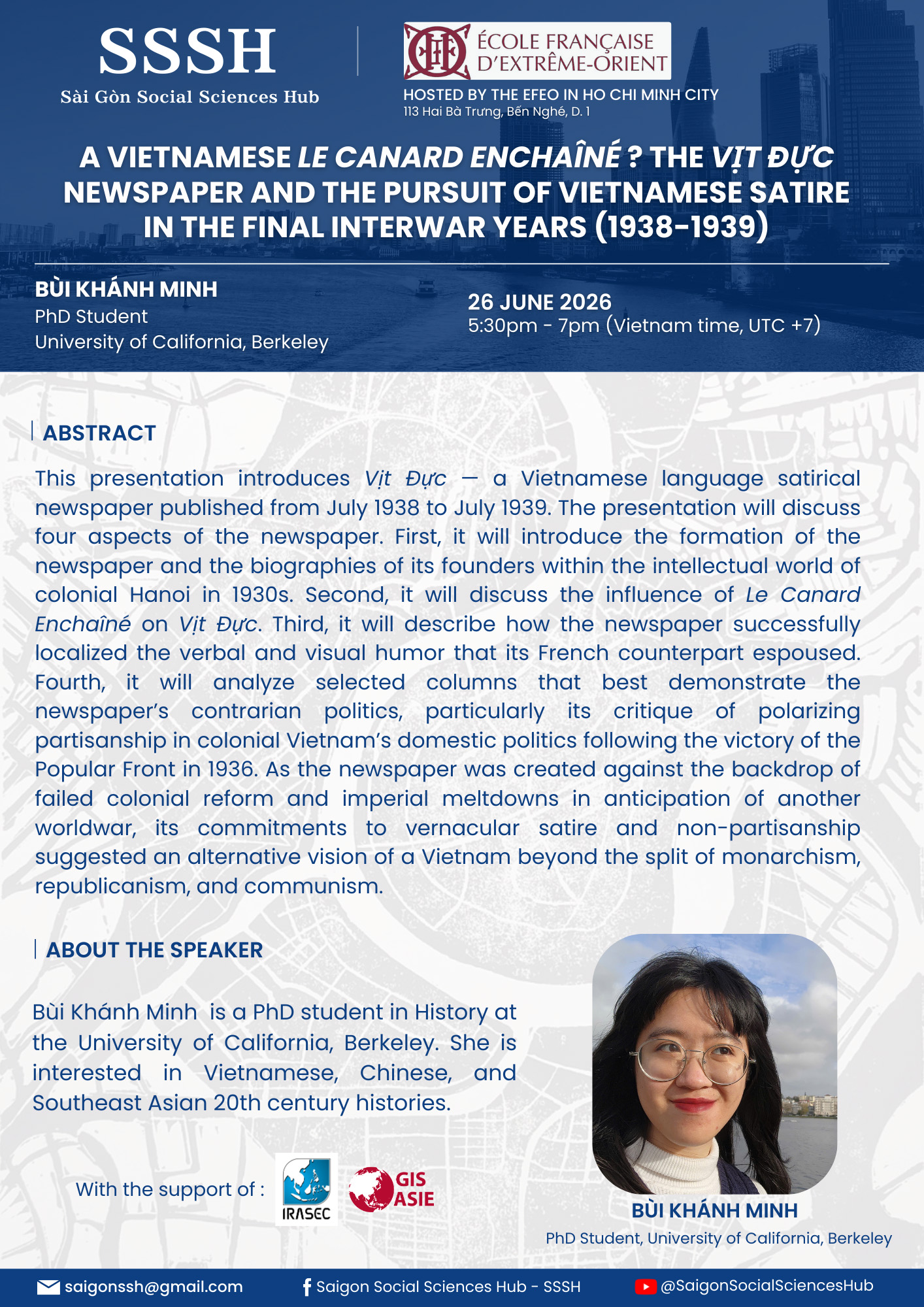
Fourth, it will analyze selected columns that best demonstrate the newspaper’s contrarian politics, particularly its critique of polarizing partisanship in colonial Vietnam’s domestic politics following the victory of the Popular Front in 1936. As the newspaper was created against the backdrop of failed colonial reform and imperial meltdowns in anticipation of another World War, its commitments to vernacular satire and non-partisanship suggested an alternative vision of a Vietnam beyond the split of monarchism, republicanism, and communism.
Journée d’étude // Workshop
Negotiating Mobilities and Borders
in Digitalising and Globalising Asia
15-16 June 2026, Departement of Sociology, National Taiwan University

Cet atelier s’inscrit dans le cadre du projet FORSEA/ORCHID, Global Mobilities in the Digital Age (NSTC/Campus France), organisé en collaboration avec le CNRS/CEFC, l’IRASEC et le Département de géographie de l’Université nationale de Taïwan, sous la direction de Hong Po-Yi et Beatrice Zani.
Cinq communications le premier jour, dont celle du professeur Hong Po-Yi qui a également présenté son prochain livre retraçant la migration du thé taïwanais, dans lequel il explore la façon dont le thé a transformé les pratiques quotidiennes des communautés taïwanaises en Thaïlande.
Le second jour, trois intervenants ont présenté leurs recherches sur le rôle des réseaux dans la formation de la mobilité et des aspirations des migrants. Le dernier sujet portait sur les femmes vietnamiennes travaillant dans les salons de massage d’une ville frontalière sino-vietnamienne

This workshop was organized as part of the FORSEA/ORCHID Project, “Global Mobilities in the Digital Age” (NSTC/Campus France), in collaboration with CNRS/CEFC, IRASEC, and the Department of Geography at National Taiwan University, under the leadership of Prof. Hong Po-Yi and Dr. Beatrice Zani.
On the first day, five presenters shared their papers, including Prof. Hong Po-Yi, who also offered a behind-the-scenes look at his forthcoming book, which explores how tea has transformed the everyday practices of Taiwanese communities in Thailand.
On the second day of the workshop, three presenters shared their research on the role of networks in shaping migrants’ mobility and aspirations.
The final presentation focused on Vietnamese women working in massage parlors in a Sino-Vietnamese border city.

/